Christina Aiello takes you into the Jacumba Wilderness, where endangered Peninsular bighorn sheep and the border wall are on a collision course, with deadly consequences.
The Jacumba Wilderness: A Desert Like No Other
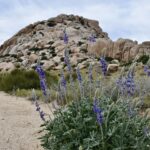
About 75 miles east of San Diego, California, the landscape begins to drastically change as the aptly named Boulder Park comes into view off Interstate 8. The hills of chaparral, scrub oak, and coastal sage give way to 4-foot-tall barrel cactus, spiny-armed ocotillo, and the sharp yet delicate blue-grey beauty of Desert Agave. You have entered the realm of some of the hardiest creatures on earth.
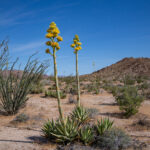
Agave and octillo, two of the plant species that thrive here.
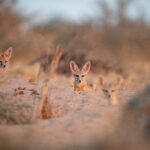
A family of kit fox living along the California-Mexico border.
The Jacumba Mountains are impressive driving past at 65 mph, but the landscape deep within the designated wilderness to the south demands a detour. Towering granite boulders that rival the world-famous climbing areas of Joshua Tree National Park, are dotted among open grassland and washes filled with lush sugar bush in the milder upper reaches of the range. The low desert valleys would shock someone not familiar with this landscape – the colors, the diversity of life, the subtle, foot-worn paths and scattered artifacts of past communities of the Kumeyaay or ‘Iipai-Tiipai ; all challenge our notions of what a “desert” can be. Far from the images conjured by the word’s Latin origin and meaning – a thing abandoned.
The mule deer, spotted skunks, ringtail cats, and lizards skittering in and out of rock crevices (some of which are only found in this specific region) would certainly disagree. The Jacumbas’ most iconic denizen, the Peninsular bighorn sheep, would give a rough snort at the thought of abandoning their home. But in the near future, they may not be left much choice as their home is split in two by the construction of a 30-foot border wall.

Meet the Horned Ghosts of the Desert
If you’ve never seen a Peninsular bighorn sheep, you’re not alone. Even people who have lived for decades near bighorn habitat have only seen them once or twice in their life, if ever. I’ve spent weeks hiking through bighorn habitat and spotted only 1 or 2, which is why I like to call them the ghosts of the desert.
When you do manage to catch a glimpse, it’s usually the striking white of their rump that you see first. Once your eyes adjust, you realize why these animals are so difficult to spot. Their pelage, or coat, is often the same earth-toned colors of the rocks they navigate. These subtle browns and greys allow them to blend perfectly into the landscape. Their wide-set, amber eyes with striking horizontal pupils were honed over hundreds of thousands of years to spot predators across open terrain for miles. If a wary ewe protecting her newborn lamb doesn’t like the looks of you, her whole family moves on. And before you even register that those amber orbs were staring down at you, they’re up and over the nearest ridge.
Awareness and movement are mechanisms for survival, especially where resources are less predictable and spread widely. But an unforgiving landscape isn’t all these sheep are up against. In Southern California, bighorn habitat has been reduced and divided, mostly by roads and other human development. Development, habitat fragmentation, and other threats reduced their numbers to 400 animals at one point. Today, desert bighorn that live in the Peninsular ranges are listed as endangered under the U.S. Endangered Species Act (ESA). This distinct population ranges from the San Jacinto Mountains near Palm Springs, south to the US-Mexico border and beyond into Baja California, though ESA jurisdiction ends at the border.
With some help and protection, they’ve persevered, and their numbers slowly increased. You don’t survive for millennia in one of the hottest regions of the U.S. and go down without a fight. Especially if you’re known for bashing together two 30-pound sets of bony, spiraled horns and walking away unfazed. But this population’s recovery is far from guaranteed, and what was a promising outlook is now being compromised.
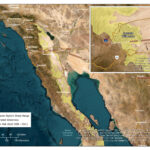
A map that illustrates the range of the peninsular bighorn sheep as of June 2026. Baja California data provided by Ruiz et al. 2025 DOI:10.12933/therya-25-6149

A Peninsular bighorn ram stands alert in arid desert scrub, his curved horns and amber eyes visible against a backdrop of dry ocotillo.

A Peninsular bighorn ewe and two young lambs navigate boulders in the Jacumba Wilderness.

Two endangered Peninsular bighorn sheep stand on a rocky outcrop in the Jacumba Wilderness, their light-colored coats blending into the rugged terrain.
The Border Wall Cuts a Habitat in Two
With the pending closure of the US-Mexico border by 30-foot steel walls, the landscape these bighorn evolved in is about to drastically change. The border cuts right across this population’s range, with less total habitat available on the US side. Subgroups of bighorn within the population use different sections of their range but regularly move between them. This ensures that genes can spread throughout the population, which promotes genetic diversity – a key component to long-term survival.
A crucial subgroup, called the Jacumba group, is the genetic ambassador to all the peninsular bighorn in Mexico. The Jacumba group, ignoring the human-imposed demarcations of nations, lives and uses habitat on both sides of the border as well as directly along it. By sealing off the border with a barrier they cannot pass, not only will this subgroup be impacted by being cut off from the resources that it has been using for generations, but the entire population will be impacted by the sudden split in their range and lack of genetic exchange across the border.
“By sealing off the border with a barrier they cannot pass, not only will this subgroup be impacted by being cut off from the resources that it has been using for generations, but the entire population will be impacted by the sudden split in their range and lack of genetic exchange across the border.”
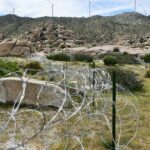
To complicate matters further, a concertina wire fence has been constructed across the border, which will eventually be replaced by a steel double wall. In the meantime, it creates a deadly hazard. These animals continue to move as they always have, and in the process, risk getting entangled and killed by a sharp fence that evolution has not prepared them to interpret as dangerous.
In other countries that have installed similar fencing along international borders, over 60 large mammals were found entangled and dead within the first 28 months. The longer this fence remains, the greater the risk of problematic mortality rates for an already small and at-risk population. Beyond immediate mortality in temporary fencing, the completed border wall will have long-term consequences on the ecology and recovery of this species, along with hundreds of others that rely on the borderlands.
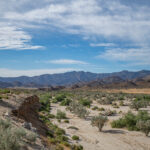 Wildlands Network
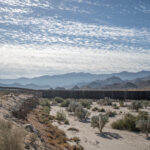
The Jacumba Wilderness in Imperial County, California before US-Mexico border wall construction, showing undivided desert habitat used by Peninsular bighorn sheep.
 Wildlands Network
A 30-foot steel border wall cuts through the Jacumba Wilderness, fragmenting critical habitat for endangered Peninsular bighorn sheep.
 Christina Aiello, Ph.D.
Concertina wire, also known as razor wire, cuts through the Jacumba Wilderness.
The First Ram in the Wire, and What Follows
I’m walking back to my car and a much-anticipated chorizo burrito waiting for me at the Valley of the Moon Trailhead, intentionally avoiding the peak heat of this early June day visit to the Jacumba Wilderness. Not four miles back, I had just documented the first known bighorn sheep mortality caused by concertina wire along the border. The hike out was striking in contrast, the smell of death still clinging to me, as I passed OHV’ers and hikers out enjoying the trail for a day. The hikers walked with casual ease, dressed as if they were strolling down a beachside boulevard rather than a dusty, desert track into a rugged wilderness.
The image was hard to forget: the unfortunate ram’s carcass, wrapped repeatedly in sharp coils, with a haggard, open-mouth expression of despair on its leathered face. I felt like I was silently carrying his tragic story, otherwise hidden deep in the California borderlands. As a biologist, wildlife death is not new to me, or generally all that upsetting to be honest. When it’s in a normal context, that is. But this border-related death and the possible deaths to come are human-caused, avoidable, and add undue strain to already vulnerable populations.
We need more people than me to recognize this problem and to work together for solutions – like a wildlife crossing being planned on nearby I-8 – to reduce other sources of mortality and prevent wildlife from disappearing in the borderlands. So that’s what we’re doing. We’re sharing the state of the border with you as we observe it, its beauty and its struggle. We’re working to ensure that the right data and resources are in place to respond to this unprecedented fragmentation and destruction on behalf of the wildlife that suffer silently.
U.S. Customs and Border Protection is currently accepting public comments on a planned 71-mile secondary barrier in Imperial County through June 29, 2026. To write in on behalf of wildlife, email ElCentroComments@cbp.dhs.gov with “El Centro Secondary Barrier Construction” in the subject line, and encourage CBP to use wildlife-accommodating border wall designs.
Support Our Work
Help us continue monitoring the wall’s impact on wildlife at the border.
Donate Today
Christina Aiello, Ph.D. | California Wildlife Biologist, Wildlands Network
Related Posts
 Myles Traphagen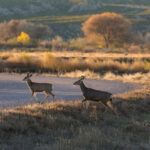
 Ron Sutherland