Plan for I-40 Pigeon River Gorge retaining wall misguided
Opinion by Dr. Ron Sutherland / Chief Scientist at Wildlands Network
After considering a few options, NCDOT has settled on building a massive concrete retaining wall to protect Interstate 40 from the raging waters of the Pigeon River near the Tennessee border. And by massive, think Hoover Dam in scale. This concrete wall will be 5 miles long, 30-70 feet tall, and 30 feet thick. No one wants to be the person who gets in the way of reopening an important highway, but before we sink a billion dollars into the project, I feel like the public needs to know there are some serious issues with the current wall plan.
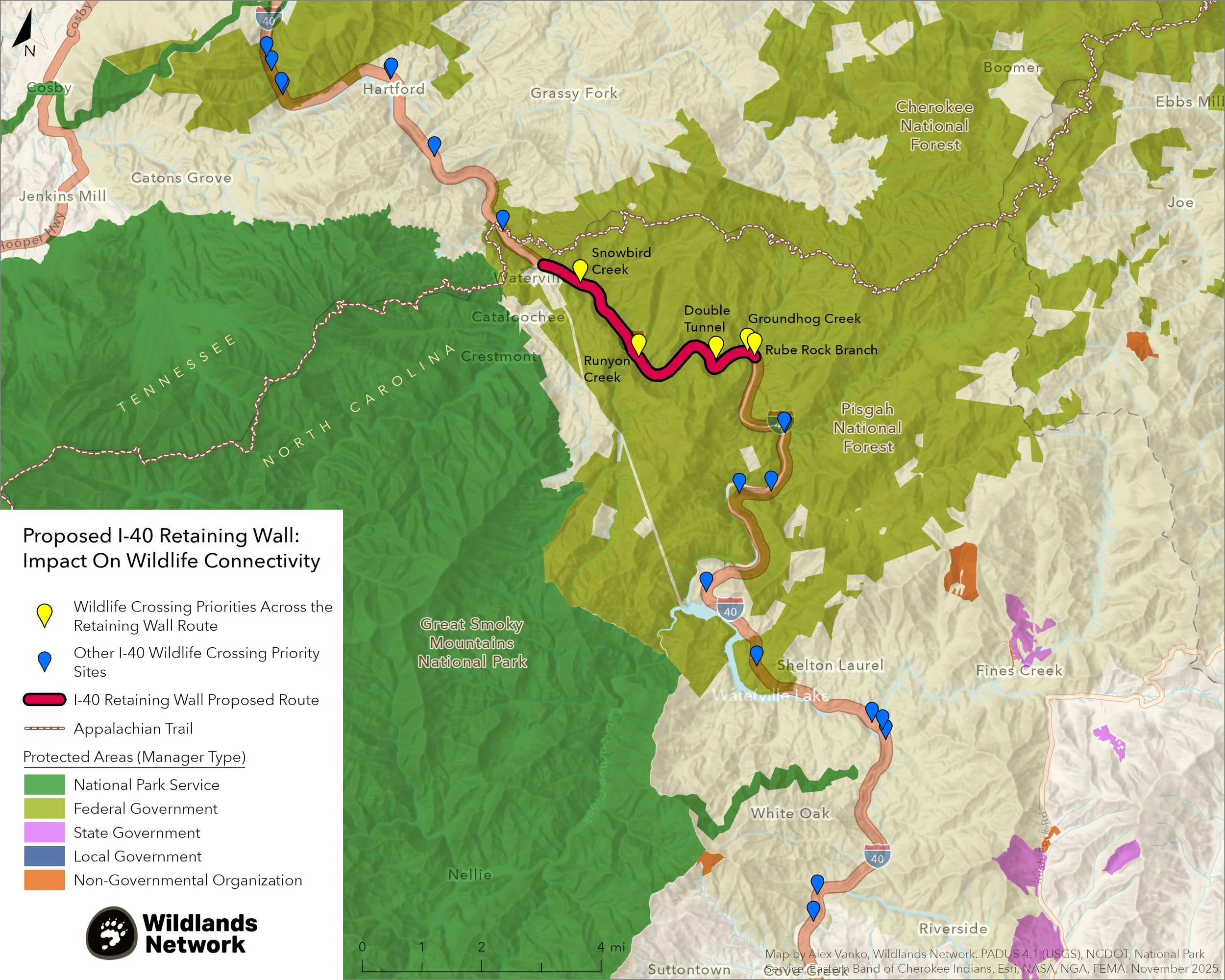
Map by Wildlands Network
The biggest flaw is that NCDOT isn’t replacing the creek culverts that pass under I-40 (and thus will need to pass through the wall). These creek culverts survived Helene, so why fix them? Well, it turns out the local rainfall in the Pigeon River Gorge area was actually pretty modest (only 6-10 inches) compared to what Helene dumped upstream (24 inches-plus). So while the river itself was a monster, the side creeks were relatively tame. Which means that we’re about to build a billion-dollar wall on top of rusty old pipes that date back to the 1960s or before. Replacing and significantly upsizing those creek culverts would require time and money, and even some additional closures of the highway. On the other hand, rebuilding the wall in just a decade or two when the increasingly warm Gulf of Mexico sends another hurricane our way would be unthinkably expensive and wasteful.
Plus, upsizing the culverts would address the second big issue, which is that the massive retaining wall will cut off habitat connectivity for wildlife across one of the more important wildlife corridors on the East Coast. Interstate 40 in the Pigeon River Gorge snakes its way right between Great Smoky Mountains National Park and Pisgah National Forest (and all of the Appalachian forests to the north). For the sake of bear, deer, elk, and countless other species, the Safe Passage Coalition (www.smokiessafepassage.org) has been working for nearly a decade now to promote better habitat connectivity options across the interstate in this critical location. While some gains have been made (you’ll note the new wildlife fencing if you drive through the Gorge) the wall would represent a permanent setback for wildlife and biodiversity, blocking the movement of many species and sending others onto the highway trying to look for a way across. Trust me, no one wants to hit a 1000-lb elk while driving through the steep and rocky Pigeon River Gorge! Adding a number of wildlife-friendly box culverts (10-12 feet wide and tall) would address the washout risk and allow for wildlife connectivity at the same time.
Lastly, it is worth pointing out that the wall itself will be a ghastly eyesore in the middle of a region known for its sublime mountain views. For many people, this will be the first thing they see as they enter North Carolina from Tennessee, an endless gray dam that turns a wild river canyon into something that will start looking like a concrete flood control canal in Los Angeles. Perhaps we ought to pause for a moment in the headlong rush to rebuild, to make sure we end up with a project that we’re actually proud of, and that doesn’t produce a huge waste of taxpayer dollars if the wall catastrophically fails during the next hurricane strike?
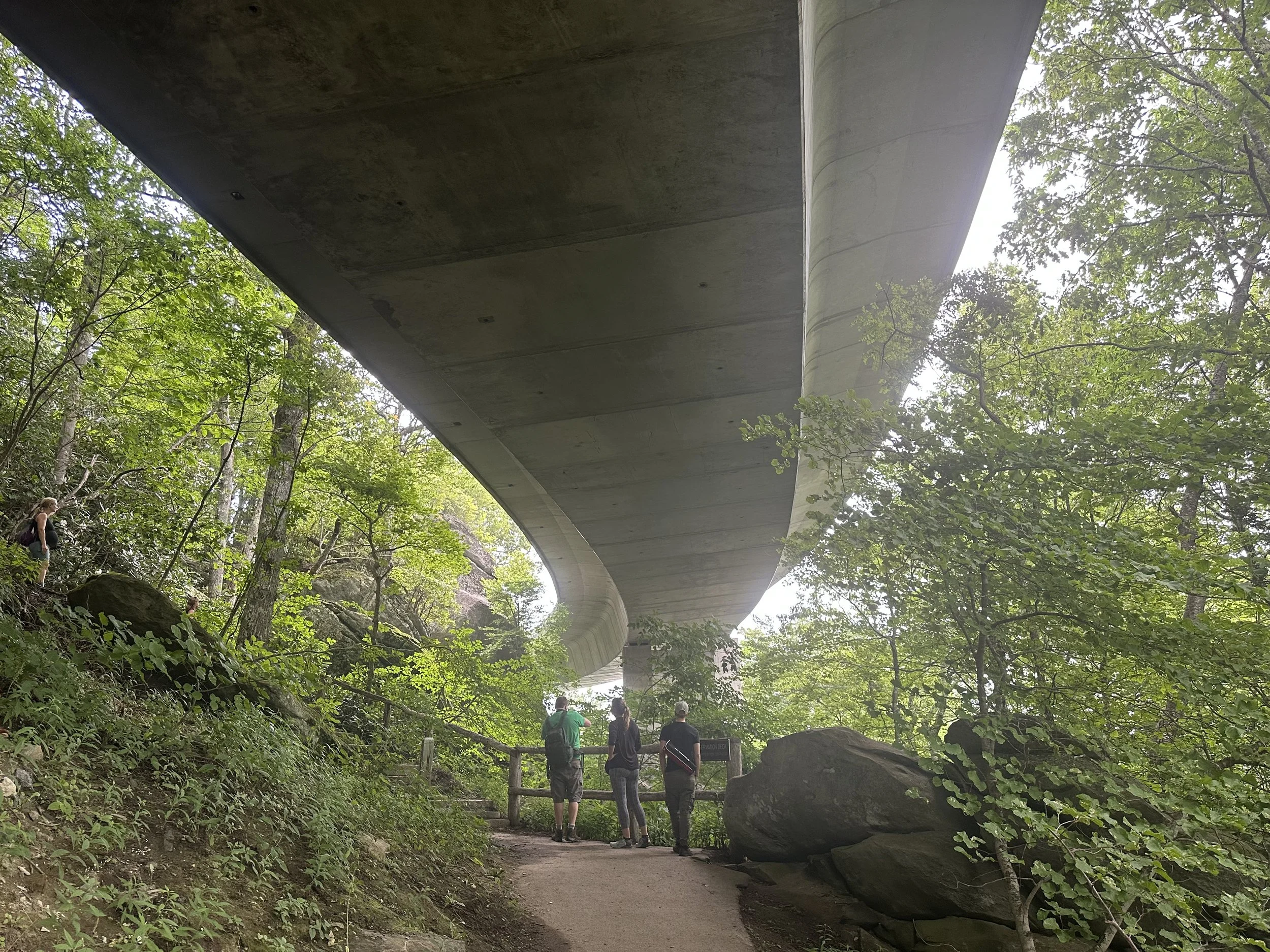
Photo by Tim Noviello
My colleagues and I had a chance to walk underneath the beautiful Linn Cove Viaduct this summer, which was designed with 1970s computer technology and built with surprising precision in the 1980s. It is a rare example of a road that truly blends into nature. Even more relevant to the scale of the Pigeon River Gorge, in 1992 the Colorado DOT finished the incredible Hanging Lake Viaduct, which carries I-70 through the narrow cliffs of Glenwood Canyon along the Colorado River west of Vail.
Now, 30-40 years after those impressive and award-winning projects, the best we can do for I-40 is a brute force sandcastle wall that simultaneously costs a fortune (what could our public schools do with a billion dollars?) and might fail anyway. Maybe instead North Carolina should invest in another world-class viaduct that will be the envy of our neighboring states, have plenty of room for wildlife and water to flow underneath, and create a beautiful tourist attraction that actually complements and enhances the visual appeal of our mountain forests?
Dr. Ron Sutherland serves as the Chief Scientist and Southeast Program Director for the nonprofit conservation group Wildlands Network